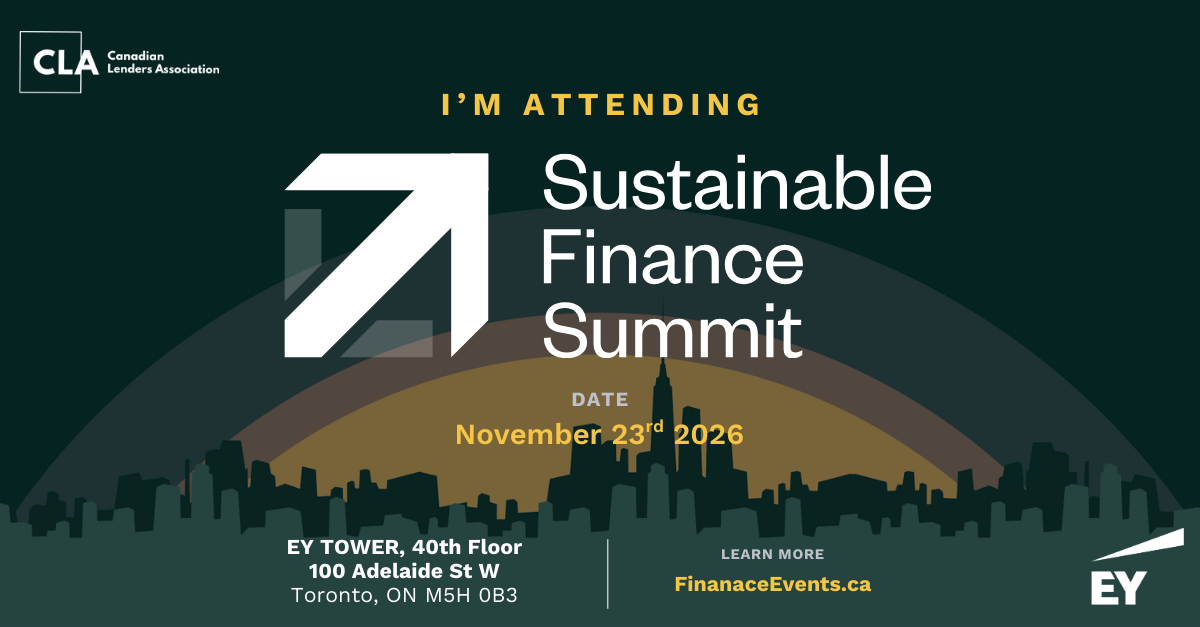
2026 Real Estate Finance Summit
The Future of Real Estate Finance β’
- Date
- November 10, 2026
- 8:00 AM EST
- Venue
- Deloitte Canada, Toronto
The Future of Sustainable Finance β’
Group Rates Available
Bring your group and save up to 15%
The 2026 Sustainable Finance Summit is Canadaβs premier forum for advancing institutional readiness in the face of the energy transition. This yearβs agenda focuses on immediate, actionable strategies: deep dives into climate risk stress testing (including OSFI B-15), practical ESG data integration, leveraging AI in risk analytics, and maximizing sustainable investment opportunities. We deliver the expert insights needed to secure regulatory compliance and enhance competitive advantage in the quickly evolving market.
This Summit is essential for C-Suite and Senior-Level Executives from Canadaβs financial sector. If your focus is Risk Management, Investment Strategy, Corporate Lending, or ESG Compliance, this is your must-attend event. We bring together leaders from major Banks, Insurers, Pension Funds, and Investment Firms. Network with policymakers and industry pioneers to align your portfolio with net-zero ambitions and build long-term financial resilience (See last year’s sold out event.)
As priorities shift and the term "ESG" faces growing scrutiny, is sustainable finance losing momentum, or simply finding a new way forward?
As priorities shift and the term “ESG” faces growing scrutiny, is sustainable finance losing momentum, or simply finding a new way forward?
Political pressures and market realities are undoubtedly reshaping how financial institutions approach sustainability. As investors navigate these changes through the lens of their distinct mandates, responsibilities and opportunities, the fundamental questions remain: where can they make a meaningful difference, and where is broader, coordinated action needed?
This opening conversation will examine the evolving business case for responsible investing, what investors can realistically achieve through capital allocation and stewardship alone, and how investment leaders are balancing climate and transition risks, evolving expectations, and long-term value creation. It will also explore the policy and regulatory changes needed to drive lasting progress, as the underlying forces driving sustainable finance remain firmly in place.

Will Europe shape Canadaβs sustainable future?
Could Europe become Canadaβs most consequential partner in sustainable finance?
What could closer CanadaβEU ties mean for sustainable finance, access to capital, disclosure and Canadian competitiveness? Closer economic ties with Europe could offer Canadian businesses new sources of capital, deeper commercial partnerships and access to markets that place different demands on sustainability performance. They could also bring more complex questions about disclosure, supply chains and the evidence investors expect before committing funds.

This panel examines what a stronger CanadaβEU relationship could mean for lenders, investors and the companies they finance. Where do Canadian assets and capabilities match European demand? When do differing standards create friction, and when can they create an advantage? The discussion will focus on turning international alignment into financing opportunities without assuming that Canadian and European priorities are interchangeable.


From resources and infrastructure to clean energy: what will make Canadian transition projects financeable at scale?
Can Canada Turn Ambition into Bankable Projects?
From resources and infrastructure to clean energy: what will make Canadian transition projects financeable at scale? Canadaβs resources, energy capacity and infrastructure needs offer a substantial investment proposition. But a compelling national opportunity does not automatically produce a project that a credit committee will approve. Investors need credible revenues, manageable construction risks, reliable counterparties and confidence in the rules governing their investment.
This panel examines the gap between transition ambition and financial close. Which obstacles require better policy, which require better project design, and which require a different allocation of risk? From clean energy and industrial investment to enabling infrastructure, the conversation will ask what governments, project developers and financial institutions must do to turn Canadian potential into transactions that can attract capital at scale.
How does Sustainable Agriculture show up in Credit, Capital and Trade?
Do sustainable farming practices improve yields, resilience, credit performance and access to global markets? For agricultural lenders and investors, sustainability must stand up to the economics of the farm. Changes in soil management, water use, inputs and production methods can affect operating costs, resilience and productivity. But the cost of adopting new practices often arrives before the financial benefits can be demonstrated.
This panel examines when sustainable agriculture becomes a stronger financing proposition. What evidence would justify different lending terms? How should institutions assess transition costs, uncertain outcomes and the demands of export markets? The discussion will connect farming practices to cash flow, credit quality and access to capital, asking how lenders can support improvements without placing an unreasonable burden of measurement or risk on producers.
Canada needs vast investment in energy, infrastructure and resources, and every major economy wants the same capital.
Fireside chat: Can Canada Win the Global Race for Capital?
Canada needs vast investment in energy, infrastructure and resources, and every major economy wants the same capital. What will it take to win it, and does sustainability strengthen Canadaβs case? Canadaβs investment needs are substantial, but global capital has alternatives. A national growth strategy must therefore answer an investorβs more demanding question: why this market, why this project and why now?
This keynote examines Canadaβs proposition in the competition for long-term investment. How do policy predictability, approval timelines, infrastructure, productivity and access to customers influence the decision to commit capital? Where can sustainability strengthen the commercial case, and where does it fail to compensate for weaknesses elsewhere? The conversation will challenge assumptions about Canadaβs natural advantages and ask what would make the country a more compelling destination for investors who can deploy their money around the world.
Β Is AI Climate Financeβs Biggest Opportunity or Newest Risk?
Is AI Climate Financeβs Biggest Opportunity or Newest Risk?
How can lenders use AI for sustainable investment while managing the physical footprint and governance risks of the technology itself? AI offers financial institutions new ways to analyse climate exposure, investigate investment opportunities and work with incomplete information. It also introduces questions about reliability, accountability and the resources required to run the technology. A faster answer is valuable only if an institution can explain why it should be trusted.
This workshop examines both sides of the investment case. Participants will explore where AI can improve sustainable lending and investment decisions, how to evaluate its outputs, and when human judgment remains essential. The discussion will also consider electricity demand, infrastructure requirements and vendor transparency, giving institutions a practical framework for assessing whether an application delivers enough value to justify its financial and environmental costs.
Can financial institutions build one credible climate-data foundation that satisfies domestic and European expectations?
One Year in & What has B-15 taught us.
Can financial institutions build one credible climate-data foundation that satisfies domestic and European expectations? A financial institution may need to use the same underlying climate information for risk management, supervisory reporting, investor requests and cross-border business. Each purpose can involve different definitions, boundaries and expectations. Collecting more data will not resolve those differences unless the institution understands what the information is meant to support.
This workshop uses experience with OSFIβs B-15 as a starting point to examine the foundations of credible climate reporting. Participants will explore data ownership, estimation, documentation, controls and the ability to trace reported figures back to their sources. The discussion will distinguish reusable information from requirements that need separate treatment, including where European obligations or counterpartiesβ requests are relevant to a Canadian institution.
How should Canada set credible and workable criteria for green and transition investment in agriculture?
What should count in Canada’s taxonomy?
How should Canada set credible and workable criteria for green and transition investment in agriculture? Agriculture presents a difficult test for any sustainable investment taxonomy. Farms differ by region, crop, production system and starting point. A credible framework must recognise those differences while giving lenders and investors enough consistency to distinguish meaningful progress from an unsupported claim.
This workshop examines how Canada should define green and transition investment in agriculture. What should qualify, how should improvement be measured, and what evidence is reasonable to expect from producers? Participants will consider thresholds, verification, regional conditions and the treatment of farms that are improving but have not yet reached an agreed standard. The objective is to identify criteria that protect market confidence while remaining practical enough to support investment.
Are credible KPIs, covenants, reporting and use-of-proceeds standards changing the economics of sustainable debt?
Will Investors Still Pay for Sustainability?
Are credible KPIs, covenants, reporting and use-of-proceeds standards changing the economics of sustainable debt? A sustainable debt label is only the beginning of the transaction. Borrowers and investors still need to agree on what the financing will achieve, how performance will be measured and what happens if commitments are missed. Those details determine whether the structure has commercial substance.
This panel examines the economics of green bonds, sustainability-linked loans and transition financing. Do stronger commitments improve pricing, attract a broader investor base or support access to capital? When do verification and reporting costs outweigh the benefits? The discussion will explore meaningful performance targets, use-of-proceeds discipline and contractual consequences, asking what separates a credible financing structure from an ordinary transaction with a sustainability label.
When insurers reprice or withdraw coverage, what happens to mortgages, collateral, infrastructure and lending decisions?
What happens to the loan when insurance becomes expensive, restrictive or unavailable?
When insurers reprice or withdraw coverage, what happens to mortgages, collateral, infrastructure and lending decisions? Insurance can provide an early signal that the economics of an asset are changing. Higher premiums, larger deductibles, exclusions or withdrawn coverage can affect a borrowerβs costs and the protection supporting a lenderβs collateral. The implications can extend well beyond the renewal date.
This panel examines how lenders and investors should respond when physical climate exposure becomes a financing issue. What should change in underwriting, valuation, loan conditions and portfolio monitoring? When can investment in resilience preserve insurability, and who should pay for it? The conversation will connect insurance decisions to mortgages, commercial property and infrastructure, asking how institutions can recognise deteriorating protection before it becomes an unexpected credit loss.
From Emissions to Resilience:Β How property data and validated AI can help lenders and insurers turn climate reporting into practical action.
Better climate data should lead to better decisions. Drawing on TD work to improve financed emissions measurement, this panel explores how credible property data and validated models can support investment, strengthen risk management and help homeowners act. Bringing together banking, insurance, climate technology and property intelligence, the discussion will examine the journey from measuring emissions to identifying practical upgrades that improve energy performance and climate resilience. What makes data trustworthy, which interventions deserve priority, and how can institutions work together to deliver measurable results?
Can Technology Deliver Sustainable Returns?
Can AI, blockchain and emerging computing technologies make sustainable finance more verifiable and investable? Financial institutions face a growing menu of technologies promising better measurement, stronger verification and more efficient investment decisions. The harder task is identifying which tools solve a material problem at a reasonable cost, and which add another layer of complexity.
This panel examines the commercial case for AI, blockchain and emerging computing applications in sustainable finance. Where can they improve the quality of evidence, reduce transaction costs or make an investment easier to assess? What prevents promising pilots from becoming useful operating tools? The discussion will focus on integration, adoption, accountability and measurable returns, asking what buyers should demand before committing budget and what providers must prove to earn a place in the institution.
Group Promo applies automatically. No promo codes needed.
Group Discount
7%
Off
Group Discount
11%
Off
Group Discount
15%
Off
EY Towers
100 Adelaide Street West
Toronto, Ontario M6J 2L3
Yes, our venue is wheelchair accessible.
We don’t provide a list of registered attendees ahead of the event. If you’re looking to connect with other attendees, the Finance Events Mobile App (where available) lets you browse the full list of registered attendees and message other delegates once you’re both registered and checked in.
Tickets can be purchased in either CAD or USD – you can pick whichever currency you’d like to shop in while reviewing the event details, before you check out. Our payment partner processes payments in multiple currencies, so you can still pay from any country supported by Stripe, regardless of which currency you choose for your ticket.
Yes. Only the person who purchased the ticket can edit attendee details, and this can be done directly from My Orders β just log in, find the order, and swap in your colleague’s name and contact details. Attendee edits close 48 hours before the event, so make any changes before then.
We don’t currently accept payment by invoice or purchase order. If credit card isn’t an option for your company, please reach out to our team via the Contact page to discuss other possible payment arrangements.
The Finance Events Mobile App lets you build your schedule, view the agenda, and connect with other attendees β but it’s not set up for every summit. Where it’s available, you’ll find the download link and setup instructions sent via email to the attendee or specified in another question. If you don’t see it mentioned for your event, that summit isn’t using the app.
Yes, Canadian Lenders Association (CLA) members receive a discounted rate. If your company is a CLA member check with your organization’s primary contact for the details or reach out to the CLA directly.
Yes β an invoice is sent to the purchaser as a PDF along with your order confirmation email. If you need another copy, it’s also available from My Orders
Invitation letters are handled on a case-by-case basis and can’t be guaranteed. A confirmed ticket purchase is generally the first step before we’re able to consider a request, so once you’ve registered, please reach out via the Contact page with your details and we’ll see what we can do.
We’d love to have you involved. Sponsorship and exhibitor packages for each of our summits β including pricing, benefits, and available tiers β are hosted on the Canadian Lenders Association website at canadianlenders.org/sponsorship. There you can browse packages specific to the event you’re interested in and see what’s still available. If you have a question that isn’t answered there, or you’d like to talk through the best fit for your company, just reach out through our Contact page and a member of our team will get back to you.
Only the ticket purchaser can update attendee details. If you bought the ticket, log into My Orders to edit the registration β job title, company, or contact information. If someone else purchased your ticket on your behalf (e.g. your company registered you), you’ll need to ask them to make the update, or have them reach out to us directly.
Unless otherwise noted on a specific event page, tickets are non-refundable. If you can’t attend, the ticket purchaser can transfer it to a colleague directly from My Orders β attendee edits close 48 hours before the event, so make the change before then. If Finance Events ever needs to cancel or reschedule an event, you’ll be offered a credit or refund.
You’ll receive a confirmation email immediately after registering with your order details and invoice. If you purchase multiple tickets, the purchaser receives the order confirmation email with the full purchase details, and each individual attendee will also receive their own separate email confirming their registration
Selected session recordings, transcripts, and highlights are shared after each summit. You can browse past sessions on our Featured Panels page, and full transcripts are published via the Canadian Lenders Association here. Not every session is recorded or transcribed, so availability can vary by event
You can view and manage your orders anytime from My Orders.
By registering you consent to being photographed and recorded (audio and video) by Finance Events and its partners. We may use, exhibit, post, display, broadcast, or distribute these photos and recordings in our external communications and on social media. Full details are in our Terms & Conditions.
Yes – by registering, your name, company, and contact details may be included in our networking app to enable attendee-to-attendee connections, unless you opt out. If you’d prefer not to be included, contact us and we’ll remove you from the networking list. Full details are in our Terms & Conditions.