2027 Canadian Finance Summit
Canada’s #1 Fintech Conference
- Date
- June 3, 2027
- 8:00 AM GMT-0400
- Venue
- The Quay, Toronto
The Future of Real Estate Finance ™
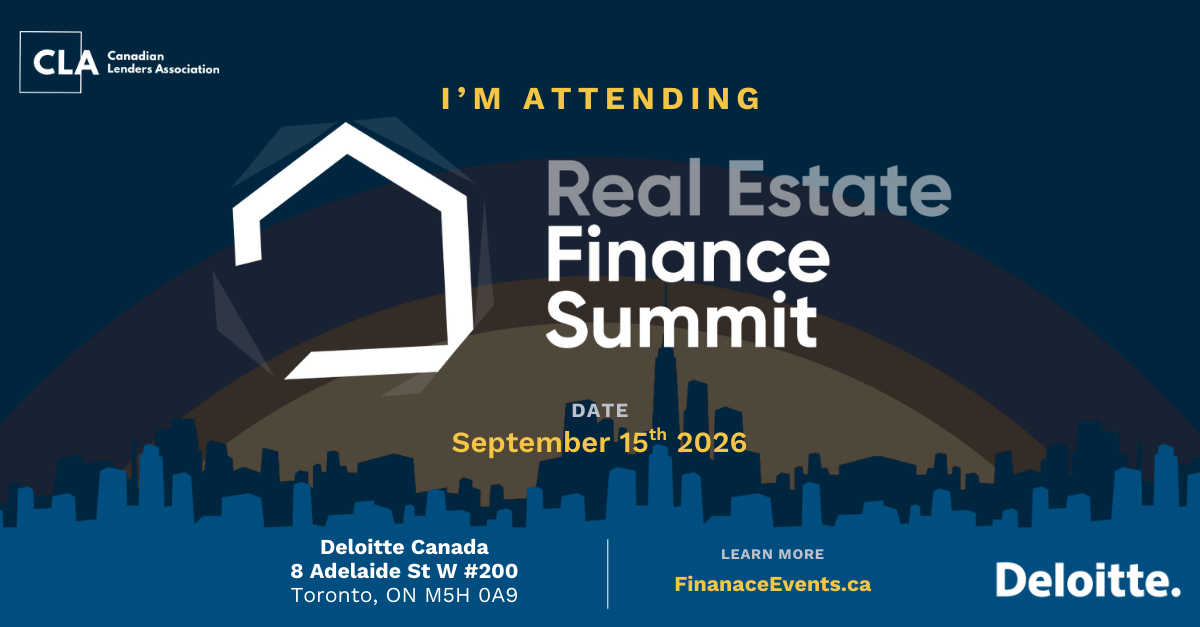
The 2026 Real Estate Finance Canada conference is the premier summit for Canadian real estate finance executives. This dedicated forum will explore the issues reshaping real estate finance, with a deep dive into industry modernization, mortgage and real estate-secured lending innovation, digital transformation, AI, risk, fraud, regulation, origination, servicing, capital flows, and the broader challenges and opportunities facing the sector.
Target attendees include senior executives from banks, credit unions, mortgage finance companies, non-bank lenders, insurers, capital providers, and fintechs. Join more than 400 professionals across credit risk, operations, servicing, compliance, and strategy for unparalleled networking and critical debate on the future of Canadian real estate finance.

Call-for-speakers and sponsors.
Governance, Accountability, and Prudence in an AI-Driven Future As lenders begin to deploy agentic AI across the mortgage value chain, OSFI’s RESL framework faces…
Governance, Accountability, and Prudence in an AI-Driven Future
As lenders begin to deploy agentic AI across the mortgage value chain, OSFI’s RESL framework faces a new level of complexity. Autonomous tools may soon support document collection, income verification, product recommendation, underwriting, servicing, renewal management, and portfolio monitoring.
This fireside chat examines how AI challenges existing expectations around accountability, explainability, model risk, borrower due diligence, governance, and supervisory confidence. Speakers will discuss what it means to maintain prudent underwriting when parts of the mortgage process are increasingly automated, adaptive, and difficult to explain.
AI, synthetic identity and financial crime in RESL Mortgage fraud is becoming faster, more scalable, and more difficult to detect. Synthetic identities, manipulated documents,…
AI, synthetic identity and financial crime in RESL
Mortgage fraud is becoming faster, more scalable, and more difficult to detect. Synthetic identities, manipulated documents, deepfakes, inflated income claims, property valuation fraud and coordinated fraud rings are converging with AI tools that can generate convincing borrower profiles and documentation at speed.
This panel explores how lenders are modernizing fraud prevention across the real estate secured lending lifecycle. The discussion will cover fraud for shelter, fraud for profit, income and property valuation fraud, document intelligence, link analysis, behavioural analytics, consortium data, explainability, and the balance between stronger fraud controls and a frictionless borrower experience.
The human role in an AI-driven mortgage journey The mortgage experience is becoming increasingly digital. Borrowers can search, apply, upload documents, receive recommendations, and…
The human role in an AI-driven mortgage journey
The mortgage experience is becoming increasingly digital. Borrowers can search, apply, upload documents, receive recommendations, and move through approval workflows with limited human interaction. But mortgages remain emotionally charged, financially significant, and highly contextual decisions.
This session examines where human judgment still matters. Panelists will discuss advice, exception handling, vulnerable borrowers, broker and advisor roles, complaints, explainability, relationship management, and the moments when automation must give way to human accountability.
The future of home ownership For many younger Canadians, the question is no longer when they will buy a home. It is whether they…
The future of home ownership
For many younger Canadians, the question is no longer when they will buy a home. It is whether they will buy one at all. Affordability pressures, income volatility, housing supply constraints, delayed family formation, student debt, climate anxiety, and changing attitudes toward work and mobility are reshaping the traditional path to ownership.
This session looks beyond affordability alone. Speakers will discuss how Gen Z and younger millennials view home ownership, what lenders need to understand about future demand, and how products, channels, underwriting, savings tools, and public policy may need to evolve for a generation that may not follow the old housing script.
Portfolio health amid the mortgage renewal wall Many Canadian borrowers who secured low-rate mortgages during the pandemic period are renewing into a materially different…
Portfolio health amid the mortgage renewal wall
Many Canadian borrowers who secured low-rate mortgages during the pandemic period are renewing into a materially different rate environment. For lenders, the question is not only whether delinquencies rise. It is how renewal pressure affects borrower behaviour, portfolio performance, credit migration, prepayment, household liquidity, and long-term customer relationships.
This session examines how institutions are monitoring portfolio health through the renewal wall. Panelists will discuss early warning indicators, payment shock, amortization pressure, loss mitigation, IFRS 9 considerations, segmentation, renewal strategy, and how lenders can distinguish temporary stress from structural borrower impairment.
The impact of climate change on collateral & property insurability The mortgage system depends on collateral that can be valued, insured, financed, and sold.…
The impact of climate change on collateral & property insurability
The mortgage system depends on collateral that can be valued, insured, financed, and sold. Climate risk is putting pressure on that assumption. Flood, wildfire, storm, heat, infrastructure failure, and insurance availability are becoming more important to property values and mortgage risk.
This panel examines how growing climate risk is reshaping the way lenders assess mortgage collateral. Speakers will discuss how property-level climate data is influencing real estate appraisals, property insurance availability, and portfolio risk, and explore the implications for underwriting, stress testing, and future lending decisions.
The expansion of private credit in real estate finance As regulated lenders face capital, underwriting, and risk appetite constraints, private credit is becoming a…
The expansion of private credit in real estate finance
As regulated lenders face capital, underwriting, and risk appetite constraints, private credit is becoming a larger part of the real estate finance ecosystem. This can provide flexibility and liquidity, but it also raises questions about transparency, borrower protection, systemic risk, pricing discipline, and the migration of risk outside the regulated perimeter.
This panel explores the growth of private credit in residential, commercial, construction, bridge, and alternative mortgage finance. Speakers will discuss where private capital is filling gaps, how risk is priced, what institutional investors are looking for, and whether Canada needs a clearer view of the shadow mortgage market.
How Agentic Software Development is Reshaping Mortgage Technology The mortgage technology landscape is entering a new era. Advances in generative and agentic AI are…
How Agentic Software Development is Reshaping Mortgage Technology
The mortgage technology landscape is entering a new era. Advances in generative and agentic AI are transforming how software is designed, built, tested, and maintained, fundamentally changing the economics and operating model of technology delivery. Tasks that once required large teams of developers, business analysts, QA testers, and support staff can increasingly be executed by autonomous or AI-assisted agents working across the software development lifecycle.
This panel explores what the rise of agentic SDLC means for mortgage lenders and servicers. Speakers will discuss how AI-powered development teams are accelerating delivery, modernizing legacy platforms, reducing technical debt, and enabling faster innovation across origination, underwriting, servicing, and customer experience. The conversation will examine how technology teams are evolving, which roles are being redefined, what capabilities remain uniquely human, and how lenders can safely govern software that is increasingly written, tested, and maintained by AI.
Ecosystems, Embedded Lending, and the Role of the Broker The mortgage distribution landscape is undergoing one of its most significant transformations in decades. Digital…
Ecosystems, Embedded Lending, and the Role of the Broker
The mortgage distribution landscape is undergoing one of its most significant transformations in decades. Digital platforms, real estate ecosystems, and embedded lending experiences are reshaping how borrowers discover, compare, and obtain mortgage products. At the same time, lenders are re-evaluating the economics and strategic value of proprietary channels, broker networks, referral partnerships, and platform-based distribution models.
This panel explores how mortgage distribution is evolving and what it means for lenders, brokers, and technology providers. Speakers will discuss the rise of ecosystem-led customer acquisition, the growing influence of digital marketplaces and embedded finance, and whether the traditional broker model remains fit for purpose in an increasingly automated and data-driven market.
State of the Commercial real estate finance market Commercial real estate finance is entering a period of profound change. Higher financing costs, office market…
State of the Commercial real estate finance market
Commercial real estate finance is entering a period of profound change. Higher financing costs, office market uncertainty, and growing requirements for building adaptation are reshaping how capital is allocated across the sector. At the same time, commercial mortgages are increasingly being managed as transferable assets, with syndications, participations and secondary transactions becoming important tools for managing risk, liquidity and portfolio strategy.
This panel explores the state of commercial real estate finance market. Where is lending returning, and where is capital remaining cautious? How are lenders approaching office refinancing, adaptive reuse and building retrofits? What makes a commercial mortgage attractive to secondary investors? And how is technology changing the way lenders underwrite, manage and distribute commercial loans?
Deloitte Canada
8 Adelaide St W #200, Toronto, ON, Canada
Toronto, Ontario M5H 0A9