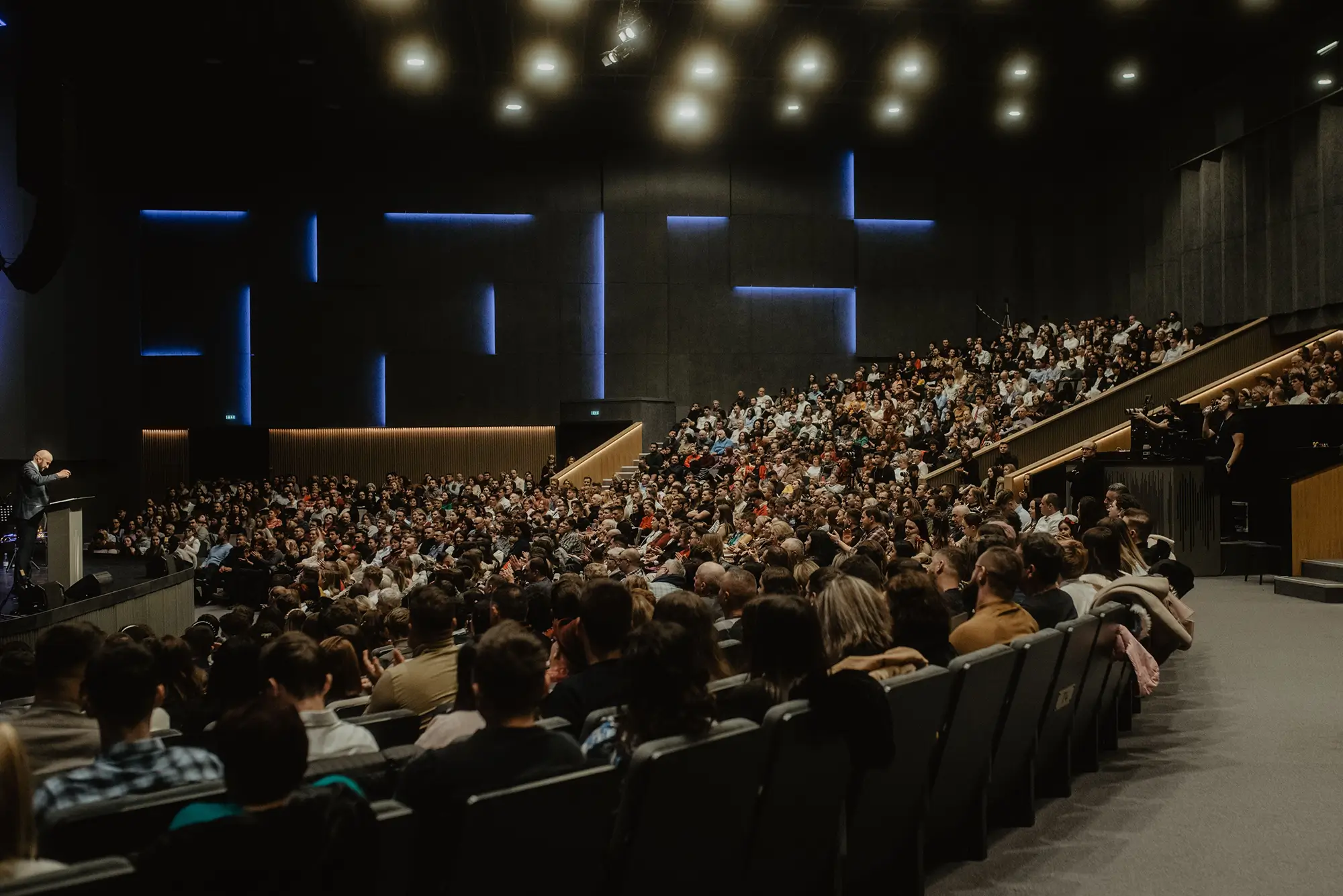






















2026 Real Estate Finance Summit
The Future of Real Estate Finance ™
- Date
- November 10, 2026
- 8:00 AM EST
- Venue
- Deloitte Canada, Toronto

The Future of Risk ™
Group Rates Available
Bring your group and save up to 15%
Risk Reimagined 2027 will bring together senior financial services leaders in New York on January 20th, 2027 at EY to examine how risk is being reshaped by technology, regulation, market volatility, fraud, cyber threats, operational dependency, and geopolitical uncertainty.
It will bring together risk, compliance, technology, data, cyber, fraud, and business leaders from across North America to explore how institutions are building the capabilities required to operate with confidence in a more complex environment. The core idea is simple: risk is no longer just a brake on the business. It is becoming a steering system for the enterprise.
From capital buffers to enterprise resilience
For decades, risk management was defined by capital, liquidity, and regulatory compliance. Those disciplines still matter, but they are no longer enough. Today’s institutions are judged by whether they can keep operating, adapting, and making decisions when markets, technology, supply chains, geopolitics, and customer expectations shift at speed.
This keynote reframes risk as an enterprise resilience capability: one that protects critical services, strengthens decision-making under pressure, and helps organizations absorb shocks without losing strategic direction.
From third-party risk to third-party resilience
Financial institutions no longer operate within a neat enterprise perimeter. Cloud providers, SaaS platforms, data partners, payment rails, and critical vendors now shape the resilience of the business itself.
This panel examines how leading firms are moving beyond vendor checklists toward active dependency management. Speakers will discuss how to identify critical relationships, test operational resilience, strengthen contracts, improve visibility, and prepare for disruption when the weak point sits outside the organization.
GRC, audit, and assurance in the age of agents
AI and automation are beginning to reshape the control environment. Evidence can be generated continuously, processes can adapt in real time, and digital agents may soon execute tasks once owned by people.
This panel explores what governance, risk, compliance, audit, and SOX controls look like when work becomes increasingly autonomous. Speakers will address accountability, transparency, assurance, control ownership, and the practical steps firms are taking to modernize GRC without creating a black box.
Cyber, privacy & identity, oh no.
Cybersecurity, privacy, identity, and technology governance are no longer separate risk domains. Together, they define whether customers, regulators, and counterparties trust the institution.
This session looks at how firms are turning cyber and privacy programs into measurable trust outcomes. Panelists will discuss identity risk, data protection, deepfakes, synthetic identity, breach response, customer experience, and the governance needed to protect trust while still enabling digital innovation at scale.
Download the network app to network to setup meetings at the numbered hightops.
A practical playbook for AI-driven cyber escalation
The time between vulnerability discovery and exploitation has collapsed. Traditional triage models struggle when medium-risk issues can be chained into critical attack paths, third-party dependencies are opaque, and patching cannot move as fast as the threat.
This workshop focuses on what readiness looks like in the Glasswing era. Participants will explore decision governance, attack-path prioritization, break-glass change processes, layered defense, executive reporting, third-party exposure, and the operating model needed to respond at speed without creating organizational chaos.
Digital assets, tokenization, and the new financial perimeter
Digital assets, tokenization, and on-chain finance are moving from experimentation to infrastructure. As they do, risk no longer fits neatly into traditional categories such as market, operational, compliance, or technology risk.
This workshop examines how institutions are redefining the enterprise risk perimeter for digital assets. The discussion will cover on-chain data, controls, AML, sanctions, valuation uncertainty, smart-contract exposure, third-party infrastructure, governance, and regulatory expectations. The focus is on building risk capabilities that can scale with innovation.
How to govern models, agents, and decisions at scale
Many institutions are moving quickly to deploy copilots, decision engines, and autonomous agents. The limiting factor is no longer the technology. It is trust.
This workshop focuses on how firms are building Trusted AI as a practical operating capability. Topics include AI governance, three-lines-of-defense models, explainability, model testing, technical controls, monitoring, drift detection, accountability, and audit readiness. The goal is to help institutions scale AI adoption while maintaining control, credibility, and regulatory confidence.
From algorithms to accountable systems
AI is now shaping credit decisions, financial crime detection, customer interactions, internal operations, and risk management itself. But as adoption accelerates, institutions face a harder question: how do you govern AI as a system, not just as a model?
This keynote explores what it takes to scale AI responsibly across the enterprise. It will examine accountability, explainability, bias, human oversight, third-party dependency, controls, assurance, and the evolving role of risk leaders as AI becomes embedded in core business processes.
Financial crime in the age of modern data
Financial crime is increasingly coordinated, digital, and adaptive. It moves through networks, not isolated events.
This panel examines the shift from rules-based monitoring to intelligence-led detection. Speakers will discuss behavioural signals, graph analytics, cross-channel insights, false-positive reduction, explainability, case management, and investigative workflows. The focus is on how institutions can fight financial crime more effectively by seeing networks, patterns, and intent earlier.
Turning capital, liquidity, and scenarios into decision support
Stress testing, capital planning, and liquidity risk management are often treated as periodic regulatory exercises. Their real value is much larger: helping leaders make faster and better decisions under uncertainty.
This session explores how institutions are building more agile scenario capabilities with better data, faster analysis, clearer governance, and stronger links to management action. Panelists will discuss how to balance rigor with speed, improve executive relevance, and turn stress testing into a steering tool rather than a backward-looking report.
Redefining talent in an AI-augmented financial sector
As AI moves from experimentation into daily operations, financial institutions are rethinking what work should be done by people, what should be automated, and where human judgment matters most. Across risk, finance, compliance, operations, and customer-facing functions, the workforce is being redesigned around new capabilities, new controls, and new expectations.
This panel will examine how AI is changing the shape of teams inside financial institutions. The discussion will focus on which roles are evolving, which skills are becoming more valuable, and how leaders are preparing employees to work effectively alongside automated systems, copilots, decision engines, and agentic tools.
Download the network app to network to setup meetings at the numbered hightops.
Modernizing the model ecosystem before AI overwhelms it
For many institutions, the model environment has become fragmented, slow, and difficult to explain. Models sit across teams and platforms, changes take too long, and leaders struggle to understand how models connect or why results differ.
This workshop explores how firms are modernizing their model ecosystems to support faster decisions, stronger transparency, and better governance. Topics include model access, scenario analysis, what-if testing, model interdependencies, explainability, platform modernization, and the controls needed to scale AI safely.
Agentic AI, automation, and human judgment
Credit risk is being reshaped across origination, underwriting, monitoring, collections, and portfolio management. The opportunity is speed and consistency. The risk is losing judgment, explainability, or supervisory confidence.
This workshop examines where automation and AI can improve credit decisions, and where human judgment remains essential. Speakers will discuss credit architecture, model modernization, workflow design, data quality, explainability, model risk, operational risk, and the controls needed to move faster without compromising accountability.
Building the data backbone for AI-enabled risk management
Risk leaders want real-time insight, predictive analytics, and AI-enabled decision support. But those ambitions fail when the underlying data is fragmented, poorly owned, or not trusted.
This workshop focuses on the foundations of modern risk data: quality, lineage, governance, ownership, control, and usability. Using practical examples, including AI and productivity tools such as Microsoft Copilot, the session will examine why the same risk question can produce different answers, and how better data discipline turns AI from a liability into a trusted management tool.
Group Promo applies automatically. No promo codes needed.
Group Discount
7%
Off
Group Discount
11%
Off
Group Discount
15%
Off
EY LLP Headquarters
395 9th Avenue
New York, New York 10001
We don’t provide a list of registered attendees ahead of the event. If you’re looking to connect with other attendees, the Finance Events Mobile App (where available) lets you browse the full list of registered attendees and message other delegates once you’re both registered and checked in.
Tickets can be purchased in either CAD or USD – you can pick whichever currency you’d like to shop in while reviewing the event details, before you check out. Our payment partner processes payments in multiple currencies, so you can still pay from any country supported by Stripe, regardless of which currency you choose for your ticket.
Yes. Only the person who purchased the ticket can edit attendee details, and this can be done directly from My Orders — just log in, find the order, and swap in your colleague’s name and contact details. Attendee edits close 48 hours before the event, so make any changes before then.
We don’t currently accept payment by invoice or purchase order. If credit card isn’t an option for your company, please reach out to our team via the Contact page to discuss other possible payment arrangements.
The Finance Events Mobile App lets you build your schedule, view the agenda, and connect with other attendees — but it’s not set up for every summit. Where it’s available, you’ll find the download link and setup instructions sent via email to the attendee or specified in another question. If you don’t see it mentioned for your event, that summit isn’t using the app.
Yes, Canadian Lenders Association (CLA) members receive a discounted rate. If your company is a CLA member check with your organization’s primary contact for the details or reach out to the CLA directly.
Yes — an invoice is sent to the purchaser as a PDF along with your order confirmation email. If you need another copy, it’s also available from My Orders
Invitation letters are handled on a case-by-case basis and can’t be guaranteed. A confirmed ticket purchase is generally the first step before we’re able to consider a request, so once you’ve registered, please reach out via the Contact page with your details and we’ll see what we can do.
We’d love to have you involved. Sponsorship and exhibitor packages for each of our summits — including pricing, benefits, and available tiers — are hosted on the Canadian Lenders Association website at canadianlenders.org/sponsorship. There you can browse packages specific to the event you’re interested in and see what’s still available. If you have a question that isn’t answered there, or you’d like to talk through the best fit for your company, just reach out through our Contact page and a member of our team will get back to you.
Only the ticket purchaser can update attendee details. If you bought the ticket, log into My Orders to edit the registration — job title, company, or contact information. If someone else purchased your ticket on your behalf (e.g. your company registered you), you’ll need to ask them to make the update, or have them reach out to us directly.
Unless otherwise noted on a specific event page, tickets are non-refundable. If you can’t attend, the ticket purchaser can transfer it to a colleague directly from My Orders — attendee edits close 48 hours before the event, so make the change before then. If Finance Events ever needs to cancel or reschedule an event, you’ll be offered a credit or refund.
You’ll receive a confirmation email immediately after registering with your order details and invoice. If you purchase multiple tickets, the purchaser receives the order confirmation email with the full purchase details, and each individual attendee will also receive their own separate email confirming their registration
Selected session recordings, transcripts, and highlights are shared after each summit. You can browse past sessions on our Featured Panels page, and full transcripts are published via the Canadian Lenders Association here. Not every session is recorded or transcribed, so availability can vary by event
You can view and manage your orders anytime from My Orders.
By registering you consent to being photographed and recorded (audio and video) by Finance Events and its partners. We may use, exhibit, post, display, broadcast, or distribute these photos and recordings in our external communications and on social media. Full details are in our Terms & Conditions.
Yes – by registering, your name, company, and contact details may be included in our networking app to enable attendee-to-attendee connections, unless you opt out. If you’d prefer not to be included, contact us and we’ll remove you from the networking list. Full details are in our Terms & Conditions.